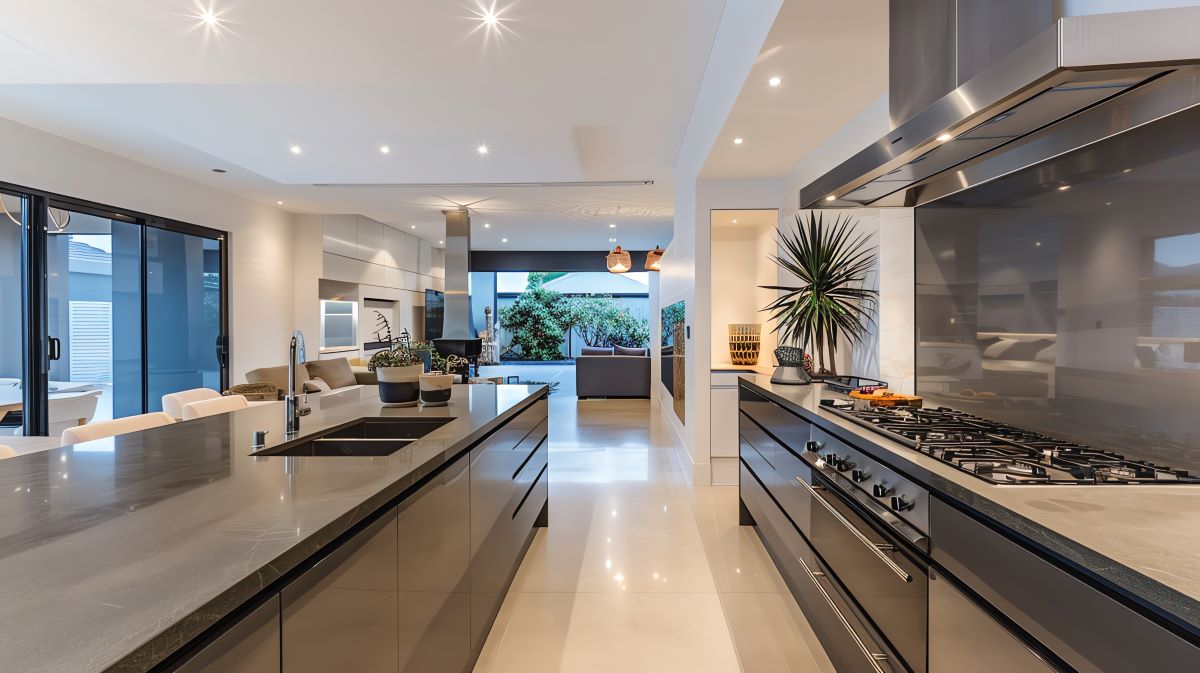
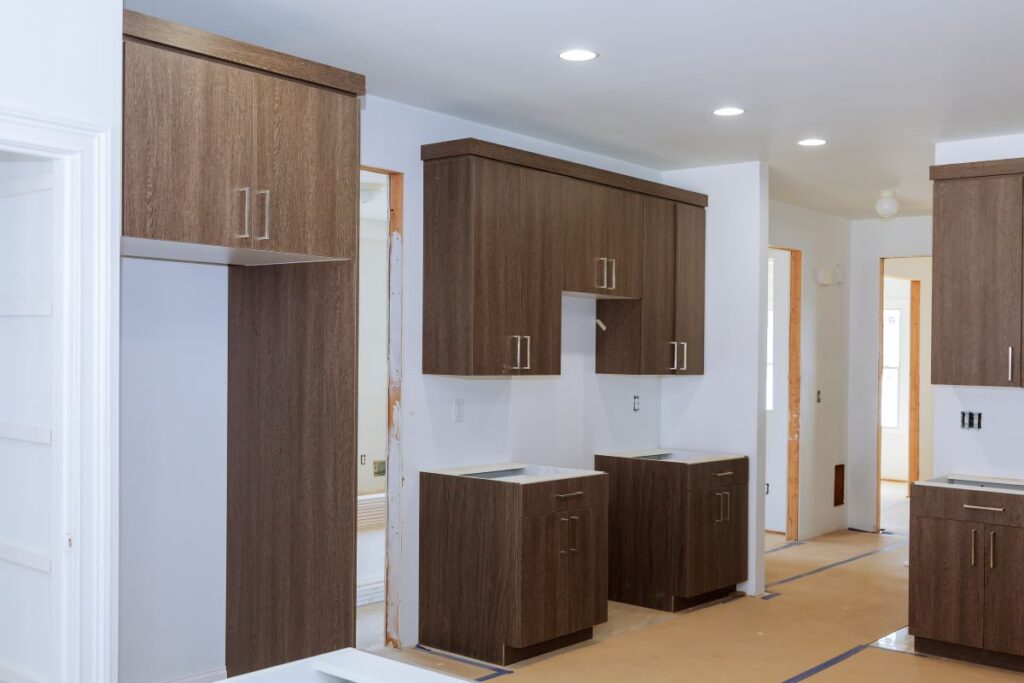
You open a drawer. It sticks. You look at your cabinets. They don’t reach the ceiling. There is a weird gap on the side.
Annoying, right?
Most homeowners think they have to live with this. You don’t.
Cabinet millwork changes everything. It means building cabinets specifically for your space. For your walls. For your stuff.
At All One Kitchen, we serve homeowners across New York and New Jersey. We see the same problem every week. People buy stock cabinets from a big store. Then they call us because nothing fits right.
Let me show you why custom millwork works better. And why it might cost less than you think in the long run.
Quick Answer Box
What is cabinet millwork and is it worth the money?
Cabinet millwork means building custom cabinets from raw materials for your exact kitchen dimensions. It costs 30% to 50% more than stock cabinets upfront. But custom cabinets add 15% to 20% more home value. They last 25+ years compared to 10-15 years for stock. For most New York and New Jersey homeowners with older homes or unique layouts, the extra cost pays off in better fit, stronger materials, and no wasted space.
Cabinet Millwork: What Homeowners Need to Know
Let’s start with the basics. Cabinet millwork is not the same as buying a box from a home center.
Millwork is custom. Built by hand or with precision equipment for one specific kitchen. Yours.
Why Stock Cabinets Fail Most Homeowners
Stock cabinets come in standard sizes. Your kitchen is not standard.
Walls are rarely perfectly straight. Floors slope. Corners are odd. Stock cabinets don’t care about any of that. You just shove them in and add filler strips.
Here is what we see on job sites across New Jersey:
- Gaps at the ceiling that collect grease and dust
- Drawers that hit cabinet handles on the other side
- Wasted corner space where a lazy susan should go
- Toe kicks that don’t line up because the floor is uneven
- Cabinet millwork solves every single one of these problems.
All One Kitchen Advice: Before you buy anything, take a level to your kitchen walls. Check the floor. If anything is off by more than a quarter inch, stock cabinets will look bad. Go custom.
The Cost Reality
People worry about budget. That is fair.
Custom millwork costs more upfront. A typical stock kitchen might run $5,000 to $12,000. A custom millwork kitchen runs $15,000 to $35,000 for most NY/NJ homes.
But here is what competitors don’t tell you. You will replace stock cabinets in 10 to 15 years. Custom cabinets last 25 years or more.
Break that down per year. Stock costs $500 to $1,200 per year of use. Custom costs $600 to $1,400 per year. Almost the same. But you get a better kitchen every single day.
Common homeowner mistake: Only looking at the upfront price tag. Look at cost per year instead.
Custom Kitchen Cabinets
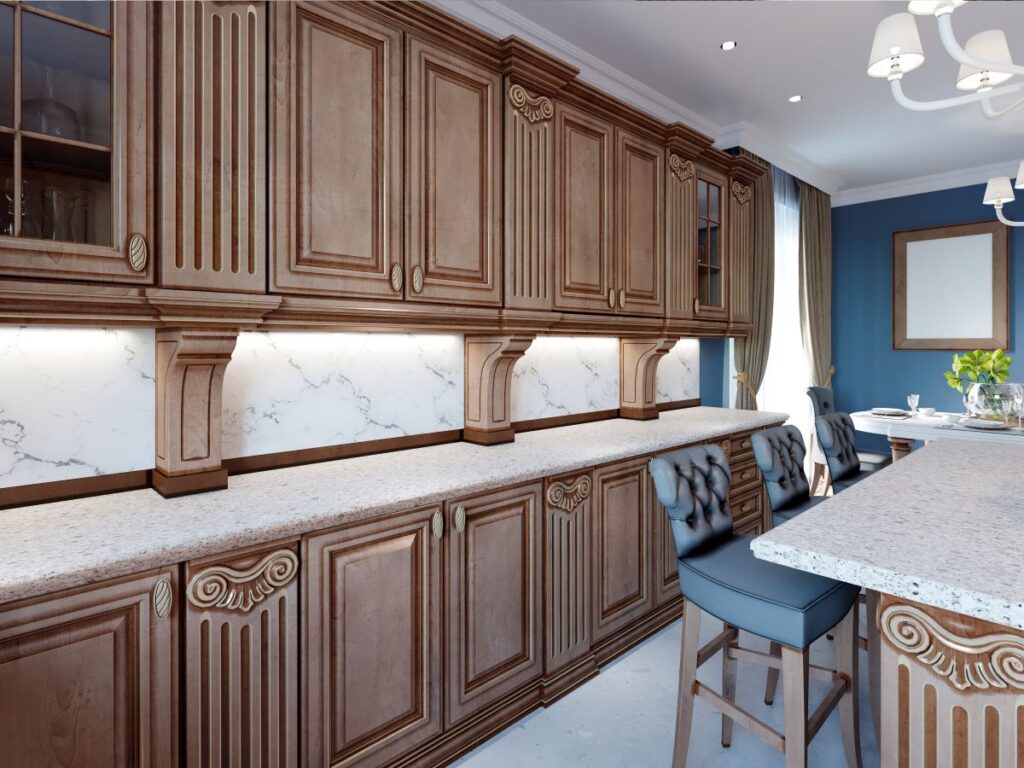
Now let’s talk about custom kitchen cabinets. This is where the magic happens.
Custom means you choose everything. Wood type. Finish. Door style. Drawer depth. Pull out shelves. Trash can hideaway. Knife block insert.
You cannot get that from a stock catalog.
How Custom Cabinets Fit Your Real Life
Think about your actual day in the kitchen.
Do you have a collection of tall water bottles? Standard shelves waste that height. Custom cabinets can add a tall pull out.
Do you hate bending over for pots? Custom drawers solve that.
Are you left handed? Custom layouts can put your prep space on the correct side.
These are not small things. They change how you feel in your kitchen every single day.
Facts: Custom cabinets are designed to fit the specific dimensions and style preferences. They allow for unique layouts and features that standard cabinets cannot provide.
We proved this last year in a Staten Island project. The homeowner had a 30 inch wide awkward space between a window and a doorway. Stock cabinets would have left a 6 inch filler. Instead, we built a custom spice pull out that used every inch. She got 30 spice bottles in that space.
Materials That Last
Not all cabinets are built the same. Here is what you need to know about cabinetry materials.
| Material | Best Use | Durability | Cost |
|---|---|---|---|
| Solid wood | Doors and face frames | Excellent | High |
| Plywood | Cabinet boxes | Very good | Medium |
| MDF | Painted doors | Good (won’t warp) | Medium |
| Particleboard | Nothing in a kitchen | Poor | Low |
Commonly used materials in cabinetry are solid wood, plywood, and particleboard. Also medium-density fiberboard (MDF). They all have different levels of durability and aesthetic appeal.
Professional insight: Look at the back panel of a stock cabinet. Often it is thin cardboard. Now knock on a custom cabinet back. You will hear solid wood or thick plywood. That difference matters when you hang heavy pots on the door.
Cabinet Finishes That Last
Cabinet finishes come in many options. Painted. Stained. Custom-glazed. Homeowners pick the look that fits their personal style.
Painted finishes need more care. They show fingerprints. But they look clean and modern.
Stained finishes hide wear better. They show the wood grain. Great for busy family kitchens.
Custom glazed finishes add depth. They cost more but look like furniture.
What you pick for cabinet materials and finishes changes a room. The way it looks. How well it works. Durability. Upkeep. Price. All of it.
Custom Cabinet Maker
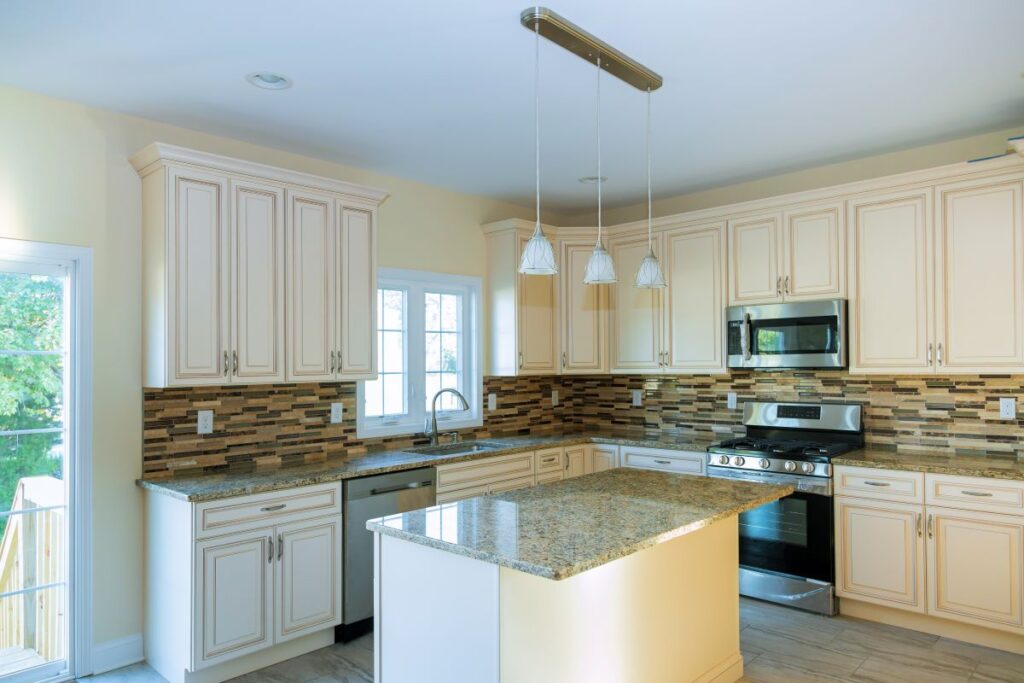
Not every contractor is a custom cabinet maker. There is a real difference.
A custom cabinet maker builds from raw lumber. They understand joinery, wood movement, grain matching, and finishing chemistry.
A handyman installs boxes from a truck.
What to Look For
Ask these questions before you hire anyone:
- Do you build your own doors or buy them prefabricated?
- What joinery do you use for drawers? (Answer should be dovetail.)
- Can I see photos of your work in real homes?
- Do you handle cabinet installation or just the build?
A real custom cabinet maker will have answers ready. They will talk about sanding grits, wood species, and finish coats. A salesperson will talk about colors and promotions.
Making custom cabinets takes teamwork. You and the cabinet maker talk it through. That way the final product looks good and works right for your functional needs.
The Timeline From Start to Finish
Here is a realistic timeline for cabinet millwork in New York or New Jersey.
| Step | Time | What Happens |
|---|---|---|
| Design consult | 1-2 hours | We measure, talk ideas, check budget |
| Detailed drawings | 1-2 weeks | You approve every detail |
| Build cabinets | 5-7 weeks | Quality construction in our shop |
| Finishing | 1-2 weeks | Staining, painting, or glazing |
| Cabinet installation | 2-5 days | Professional installation by our team |
| Final walkthrough | 1 day | You check everything, we adjust |
Total time: 9 to 12 weeks.
Yes, that is longer than buying stock. But you get customers who call us years later saying thank you. That does not happen with stock.
Design Consultations Matter
Cabinet makers often provide design consultations to help clients visualize their space and select the best cabinet styles and layouts before installation begins.
We spend real time with clients at All One Kitchen. We ask about your lifestyle. Do you bake? Do you have kids? Do you entertain a lot?
Those answers change the design.
A baker needs deep counters for mixers. A family needs soft close drawers so little fingers don’t get pinched. An entertainer needs open shelving for serving pieces.
Stock cabinets ignore all of this. Custom pays attention.
Pro Tip: Before your design consult, make a list of everything in your current kitchen that annoys you. Every single thing. Give that list to your cabinet maker. They will design around your frustrations.
Architectural Millwork
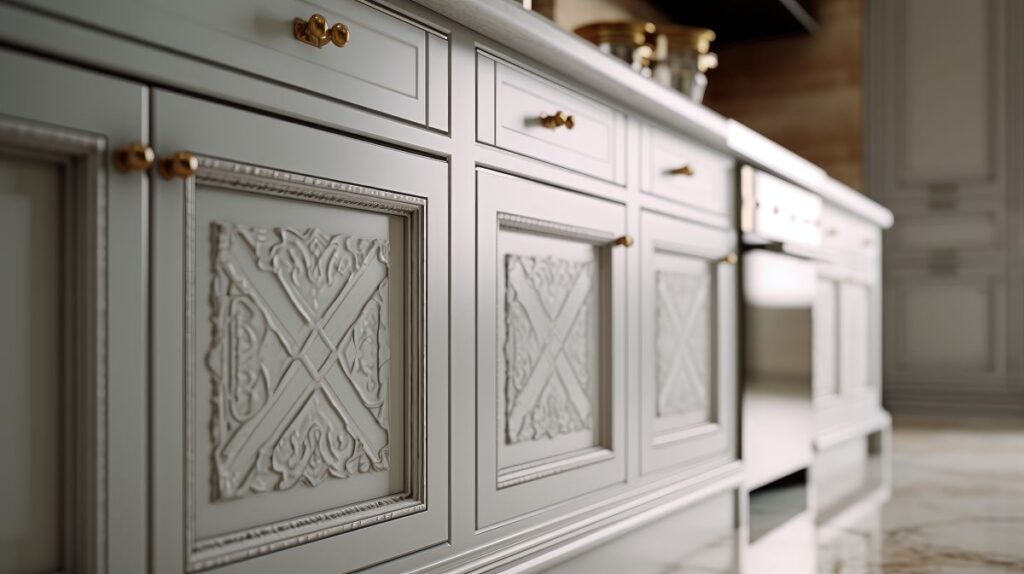
Architectural millwork sounds like a fancy term. It just means built in woodwork that matches your home’s style.
This includes:
- Crown molding on top of cabinets
- Paneled ends for exposed cabinet sides
- Built in range hoods
- Decorative feet on islands
- Matching trim around windows
Why Architectural Millwork Adds Value
Custom cabinetry boosts your home’s value. Buyers see them as a premium feature. They add good looks and practical use to any room.
When you add architectural millwork, the whole kitchen looks intentional. Not like someone dropped boxes into a room.
Real estate agents in New York and New Jersey will tell you. Buyers notice custom millwork. They will pay more for a home with it.
We have seen this firsthand. A residential kitchen in Bergen County with full architectural millwork sold for $40,000 more than a nearly identical home down the street with stock cabinets.
Matching Your Home’s Character
New York and New Jersey have diverse home styles. Brownstones. Colonials. Mid century splits. Farmhouses.
Architectural millwork lets you match the cabinet style to the house.
A brownstone gets raised panel doors and substantial crown molding. A mid century gets flat slab doors with minimalist trim. A farmhouse gets beadboard panels and chunky edges.
Stock cabinets come in three styles. Maybe four. They cannot match your home’s character the way custom millwork can.
Cabinet Manufacturing Techniques
Ever wonder why some cabinets fall apart after five years? It comes down to cabinet manufacturing techniques.
Good vs. Bad Construction
Here is what quality looks like behind the scenes.
Bad techniques (avoid these):
- Stapled joints with no glue
- Butt joints held only by nails
- Drawers made from particleboard
- Cam lock fasteners (like IKEA)
- Thin 1/4 inch back panels
Good techniques (look for these):
- Dado and rabbet joints for cabinet boxes
- Dovetail drawer boxes
- Mortise and tenon door frames
- Face frames glued and screwed to boxes
- 1/2 inch or thicker plywood backs
Cabinet installation services typically include the assembly and fitting of cabinets in various spaces. Such as kitchens, bathrooms, and offices.
Professional cabinet installation ensures that cabinets are securely mounted. And that they are aligned properly. It is crucial for both aesthetics and functionality.
Refacing vs. Full Replacement
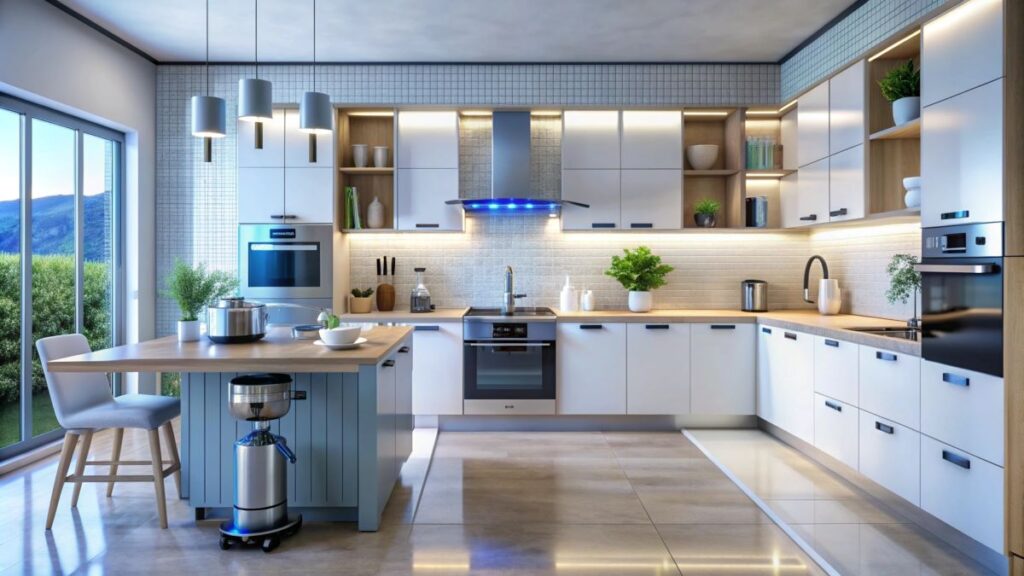
Not everyone needs to rip everything out. Sometimes your boxes are fine. The doors just look old or damaged.
Cabinet refacing keeps your existing box structure. We replace the doors, drawer fronts, and hardware. Then apply new veneer to the exposed frames.
Replacing cabinets removes everything. Old boxes. Old layout. All of it.
Refacing only changes the exterior surfaces of cabinets. Doors and drawer fronts get swapped. The frame stays. This causes less disruption than a full replacement.
Replacement means taking out every old unit. Then putting new ones in. It takes more work and costs more money than refacing.
Refacing is faster and cheaper. Homeowners get a fresh look without much interruption to their daily routine.
Here is how to decide which path is right for you.
| Your Situation | Best Option | Timeline | Cost Range |
|---|---|---|---|
| Boxes are solid, layout works | Refacing | 3-5 days | 4,000−10,000 |
| Boxes are falling apart | Full replacement | 2-4 weeks | 15,000−35,000 |
| You want a different layout | Full replacement | 2-4 weeks | 15,000−35,000 |
| Budget is tight but cabinets look dated | Refacing | 3-5 days | 4,000−10,000 |
| You are selling within 2 years | Refacing | 3-5 days | 4,000−10,000 |
Common homeowner mistake: Refacing when the boxes are water damaged or rotted. New doors on rotten boxes is a waste of money. Be honest about your box condition first.
Millwork Shop Near Me
Searching for a millwork shop near me in New York or New Jersey? Here is what you need to know before you call.
What to Ask Before Hiring
Call three local shops. Ask these exact questions:
- Do you handle both build cabinets and cabinet installation?
- What is your current lead time from deposit to finish?
- Can you match an existing stain or paint color exactly?
- Do you offer design help or do I need my own plans?
- Can you show me three recent projects in my area?
Local insight: Homes in North Jersey and the five boroughs often have plaster walls that are not straight. Plaster bows and waves. Stock cabinets look terrible against wavy plaster. Custom cabinet millwork solves this because we scribe the cabinets to the actual wall. No gaps. No filler strips.
Why All One Kitchen Serves Your Area
We are proud to serve homeowners across:
- All five New York City boroughs
- Long Island
- Westchester County
- Northern New Jersey (Bergen, Essex, Hudson, Morris, Passaic, Union counties)
- All nearby communities
We understand the unique needs of residential properties here. Pre war buildings with uneven floors. Suburban splits with odd angles. Coastal properties near the shore with humidity concerns.
Cabinet millwork done right handles all of it.
All One Kitchen Advice: Do not hire a business that only builds cabinets but does not install them. When something goes wrong, the builder blames the installer and the installer blames the builder. Hire one team for everything.
Want to learn what cabinet millwork looks like for your actual kitchen? All One Kitchen offers free design consultations across New York and New Jersey. We will measure your space, talk about your budget, and show you real material samples. No pressure. Just honest information and years of experience. [Contact our team today and schedule a time.]
Frequently Asked Questions
How much more do custom cabinets cost than stock cabinets?
Expect to pay 30% to 50% more for true cabinet millwork. Stock runs $100 to $300 per linear foot. Custom runs $500 to $1,200 per linear foot. But custom lasts 25+ years. Stock lasts 10-15 years. The yearly cost is very close.
How long does custom cabinet installation take from start to finish?
Building takes 6 to 8 weeks. Cabinet installation takes 2 to 5 days for an average kitchen. Full timeline from first design meeting to finished kitchen is usually 9 to 12 weeks.
Can I reface my existing cabinets instead of full replacement?
Yes, if your cabinet boxes are in good shape and you like your current layout. Refacing costs about half as much as replacement. It takes 3 to 5 days and is much less disruptive to your daily life.
What is the best wood for kitchen cabinets in NY/NJ homes?
Maple and cherry are great for durability. Oak is strong but has bold grain that some people don't like. Poplar is excellent for painted finishes. Avoid pine in high use areas. It dents too easily, especially in busy family kitchens.
Do custom cabinets really add home value?
Yes. Appraisers and real estate agents typically say custom cabinetry adds 15% to 20% more home value than stock cabinets.
Conclusion
Cabinet millwork is not for everyone. But for many homeowners in New York and New Jersey, it is the best decision they make.
You get cabinets that actually fit your space. Materials that last. A design that matches your lifestyle. And quality that stock cabinets simply cannot match.
Custom kitchen cabinets from a real custom cabinet maker solve the problems that stock cabinets create. No gaps. No wasted corners. No disruptive replacements every 10 years. Only practical solutions.
If you are tired of fighting your kitchen, learn more about All One Kitchen. We have years of experience across New York and New Jersey. We will answer your questions honestly. Give you real information and free quote. And build cabinets you will be proud of for decades.